
Strength training builds more than muscles. It builds confidence, resilience, discipline, and the belief that we are capable of more than we think.
When we think about strength training for kids, we often focus on the physical benefits: stronger muscles, healthier bones, improved coordination, and better athletic performance.
But what if some of the greatest benefits of strength training have very little to do with physical strength?
What if the gym could also become one of the best places for kids to develop mental toughness?
For children ages 9–16, strength training offers something unique. It provides a hands-on opportunity to experience challenges, work toward goals, overcome frustration, and see firsthand what happens when effort and consistency meet patience.
They don't just hear adults talk about perseverance, confidence, and hard work. They get to experience those qualities.
This is where strength training connects beautifully with the 4Cs Model of Mental Toughness: Control, Commitment, Challenge, and Confidence.
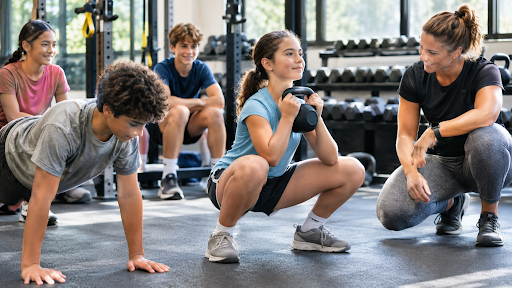
The Connection Between Physical Strength and Mental Toughness
Mental toughness isn't about never struggling, never getting frustrated, or always being the strongest person in the room.
It's about learning how to respond when things get difficult.
Strength training provides a safe, structured environment where kids can practice these skills. Every workout presents opportunities to make choices, work toward goals, face challenges, and recognize personal progress.
Let's look at how each of the 4Cs develops through strength training.
1. CONTROL — I Am in Charge of My Choices
One of the most important lessons children can learn is that while they cannot control everything that happens around them, they can control how they respond.
Strength training reinforces this concept every time they walk into the gym.
They learn to control:
Their effort and attitude.
Their breathing and technique.
How they respond when an exercise feels difficult.
Whether they ask for help or adjust their approach.
How they respond to mistakes and setbacks.
For example, a child might struggle with a particular exercise. They can become frustrated, give up, or choose to slow down, listen to coaching, and try a different approach.
That is control in action.
The life lesson: I cannot control everything that happens to me, but I can control how I respond.
2. COMMITMENT — I Get Stronger Through Consistency
Strength doesn't happen overnight. It takes time, patience, and repeated effort.
This is one of the most valuable lessons strength training can teach young people.
Kids begin to understand that:
Progress takes time.
Showing up matters.
Small efforts accumulate.
Goals require patience and practice.
Consistency is more important than one great workout.
A child might not notice much improvement after one session. But after several weeks of showing up, practicing, and putting in consistent effort, they begin to see and feel the difference.
They discover that progress is the result of the little things they do repeatedly.
This lesson extends far beyond the gym. It applies to school, relationships, learning an instrument, playing sports, and pursuing personal goals.
The life lesson: I don't have to achieve everything today. I just have to keep making progress.
3. CHALLENGE — Difficult Doesn't Mean Impossible
One of the biggest barriers to confidence is the fear of doing something we might not be good at.
Strength training gives children opportunities to experience challenges in a controlled and supportive environment.
They get to experience:
Trying something they've never done before.
Feeling uncomfortable while learning a new skill.
Making mistakes and correcting them.
Discovering that their abilities can improve.
Learning that frustration doesn't mean failure.
Think about a child learning a new movement. At first, the exercise might feel awkward or difficult. Their technique might not be perfect. They might need several attempts before they begin to feel comfortable.
But with practice, instruction, and encouragement, things start to change.
Eventually, something that once seemed difficult becomes manageable.
That's a powerful experience.
Children begin to understand that being challenged isn't a sign that they can't do something. It's an opportunity to learn and grow.
The life lesson: Something being hard doesn't mean I can't do it. It means I have an opportunity to grow.
4. CONFIDENCE — I Have Evidence That I Can Improve
This might be the most powerful connection of all.
Confidence isn't simply something we tell children to have. It's something they can build through experience.
Strength training provides tangible evidence of progress.
Children can see and experience:
An exercise that once felt difficult becoming manageable.
Their technique improving.
A goal they set becoming achievable.
Their ability to accomplish something they once thought was impossible.
The satisfaction of recognizing their own progress.
These experiences help children develop a stronger belief in themselves.
Instead of simply hearing, "You can do hard things," they begin to have personal experiences that demonstrate it.
They start to believe in their ability to learn, adapt, and improve because they've experienced what happens when they practice and persevere.
The life lesson: I can trust myself because I've experienced what happens when I practice and persevere.
Strength Training and the 4Cs: Making the Connection
The 4 C’s
CONTROL
What happens in the gym - They get frustrated with an exercise
What kids learn - I can choose my response
COMMITMENT
What happens in the gym - They consistently show up and practice
What kids learn - Small steps lead to big progress
CHALLENGE
What happens in the gym - They try something new or difficult
What kids learn - Hard things help me grow
CONFIDENCE
What happens in the gym - They accomplish something they couldn’t do before
What kids learn - I am capable of improving
The Secret: Make the Connection Intentional
Here is something important to understand: simply putting kids in a weight room doesn't automatically develop mental toughness.
The environment, coaching, encouragement, and conversations surrounding the training experience matter.
We need to help children recognize that the skills they are practicing in the gym can also help them in the rest of their lives.
One simple way to do this is to incorporate four questions into the end of each workout.
The 4Cs Post-Workout Reflection
Control: What was something you controlled today?
Commitment: When did you demonstrate persistence?
Challenge: What was difficult today, and what did you learn?
Confidence: What did you accomplish today that makes you believe in yourself a little more?
These questions take just a few minutes, but they help children connect their physical experiences with personal growth.
Over time, they begin to recognize that they are developing more than physical strength. They are developing skills that can serve them throughout their lives.
What Does the Research Say?
There is growing research supporting the psychological benefits of resistance training in children and adolescents.
A 2019 systematic review and meta-analysis published in Sports Medicine – Open examined resistance training interventions in young people ages 10–16.
Researchers found significant improvements in several psychological measures, including:
Resistance-training self-efficacy (belief in one's ability to succeed).
Perceived physical strength.
Physical self-worth.
Overall self-worth.
In other words, resistance training may help young people feel better about themselves, recognize their capabilities, and develop greater confidence.
The American Academy of Pediatrics also recognizes the potential physical and psychological benefits of appropriately designed youth resistance training.
It is important to remember that strength training doesn't automatically produce every component of mental toughness. These qualities are developed through intentional coaching, positive experiences, appropriate challenges, and opportunities for reflection.
A Note About Strength Training for Kids
The goal of youth strength training should never be to lift the heaviest weight, compete against others, or prove who is the strongest.
The goal is personal improvement.
For children ages 9–16, training should be age-appropriate, supervised by qualified adults, focused on proper technique, and progressed gradually as skills and abilities develop.
Children don't need maximal lifts or extreme workouts to benefit from resistance training.
They need a positive environment where they can learn, practice, make mistakes, experience success, and develop confidence in their abilities.
Strong Body. Strong Mind.
Perhaps the most important lesson we can teach children through strength training is this:
Physical strength gives children the experience of becoming capable. Mental toughness helps them carry that belief into the rest of their lives.
When children learn that effort leads to improvement, that challenges create opportunities, and that they have control over their responses, they begin to develop a much stronger belief in themselves.
That belief doesn't stay in the weight room.
It follows them into the classroom, onto the playing field, into friendships, and eventually into adulthood.
We aren't just trying to raise stronger kids.
We're trying to help raise confident, resilient young people who believe they can face challenges, learn from setbacks, and continue growing.
Every rep is a chance to grow.
Build strength. Build character. Build confidence.
