
X-Rays in Motion
If you’ve ever had a chiropractic X-ray series, you may have wondered why your chiropractor asks you to bend your neck forward and then extend it backward for additional images.
Why take an X-ray while I’m moving my neck?
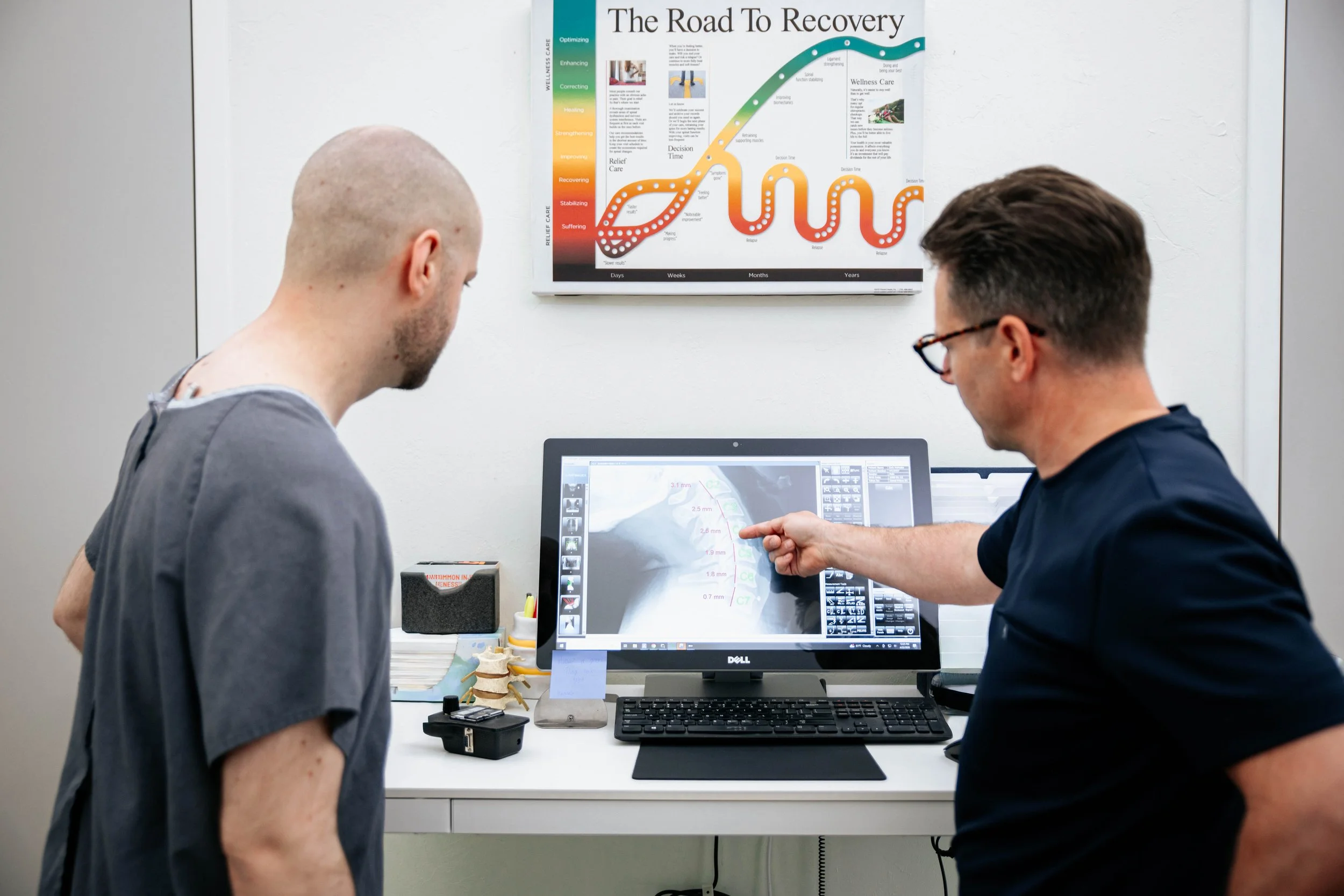
A standard X-ray shows the position of your spine while you are still. Flexion and extension X-rays add another piece of information: how the vertebrae move in relation to one another.
What Are Flexion and Extension X-Rays?
Flexion is when you bend your neck forward, bringing your chin toward your chest.
Extension is when you move your head and neck backward.
Taking X-rays in these two positions allows the chiropractor to compare the position of the vertebrae during movement. This can help identify changes in alignment or abnormal movement that may not be visible on a stationary X-ray.
Why Would Your Chiropractor Look at Movement?
The ligaments in your neck help support and stabilize the vertebrae. When the neck experiences an injury, these ligaments can become stretched or injured.
A cervical sprain can occur from several different mechanisms of injury, including:
Motor vehicle accidents
Falls
Sports injuries
Sudden impacts
Rapid acceleration or deceleration
Whiplash-like movements
Other injuries that cause the head and neck to move suddenly
During a whiplash-type injury, the head can be rapidly jolted forward and backward. This sudden movement can place significant stress on the ligaments supporting the cervical spine and may result in a sprain.
Concussions can also occur from a sudden jolt or impact that causes the head and brain to move rapidly. When an injury involves both the head and neck, evaluating the cervical spine can be an important part of understanding what happened during the injury.
What Are We Measuring?
When looking at flexion and extension X-rays, one thing that can be evaluated is translation, or how much one vertebra shifts in relation to another during movement.
Think of your vertebrae as a stack of blocks. Ideally, they should maintain an appropriate relationship to one another as you move. If one segment moves differently or shifts farther than expected compared with the surrounding segments, that may provide information about the stability of that motion segment.
The amount of movement can be measured at each individual cervical level. These measurements can then be considered along with your symptoms, physical examination findings, and history of injury.
How Does This Relate to Sprain Grading?
Cervical sprains can be described using different grading systems. Clinical grading generally considers things such as pain, stiffness, tenderness, range of motion, and neurological findings.
Dynamic X-rays provide a different type of information. Rather than grading the sprain based solely on how you feel, the images allow the provider to evaluate how the vertebrae are moving.
In other words, your symptoms tell part of the story, while the movement seen on flexion and extension X-rays can provide additional information about the mechanical behavior of the cervical spine.
Why Take Both Views?
A single X-ray taken while your neck is in a neutral position provides a snapshot of your spine at rest. Flexion and extension views allow your chiropractor to observe the spine under movement.
Your spine’s position matters, but so does how it moves.
Comparing the cervical spine in neutral, flexion, and extension positions can provide a more complete picture of spinal alignment and movement than looking at only one position.
These findings are not interpreted by the X-ray alone. Your chiropractor considers the images together with your history, symptoms, and physical examination to better understand your individual case.
Understanding the Bigger Picture
If you’ve experienced a car accident, fall, sports injury, or other event involving a sudden jolt to the head and neck, it is important to understand that an injury may involve more than what can be seen in a single static position.
Flexion and extension X-rays can provide an additional look at how the cervical spine behaves during movement and whether there are measurable changes between spinal segments.
Sometimes, understanding the spine means looking at more than where it is. It also means looking at how it moves.
